
Premium Financing
General knowledge only; not about any particular insurer or product, and not a product recommendation or investment, tax or legal advice. Policy terms and official documents prevail.
In one sentence
Premium financing means paying part of a large policy’s premium yourself and borrowing the rest from a bank, with the policy pledged to the bank. It lets you arrange a larger policy with less of your own money, but adds interest rate, currency and top-up risks.
How it works
Premium financing can be understood as “borrowing from a bank to pay the premium, with the policy as collateral”. A typical process:
- The client chooses a large policy, commonly a single-premium savings or universal life policy.
- The client pays part of the premium as a “down payment”.
- The rest of the premium is paid with a bank loan. The policy is assigned (pledged) to the bank, which sets the loan amount based on the policy’s cash value (also called the surrender value).
- The client pays interest to the bank. The rate is usually floating, based on the bank’s cost of funds or a market benchmark plus a margin.
- Payouts or growth from the policy belong to the policyholder and can be used to pay the interest.
- On a claim, surrender or loan repayment, the bank loan is repaid first and the remainder goes to the beneficiary or policyholder.
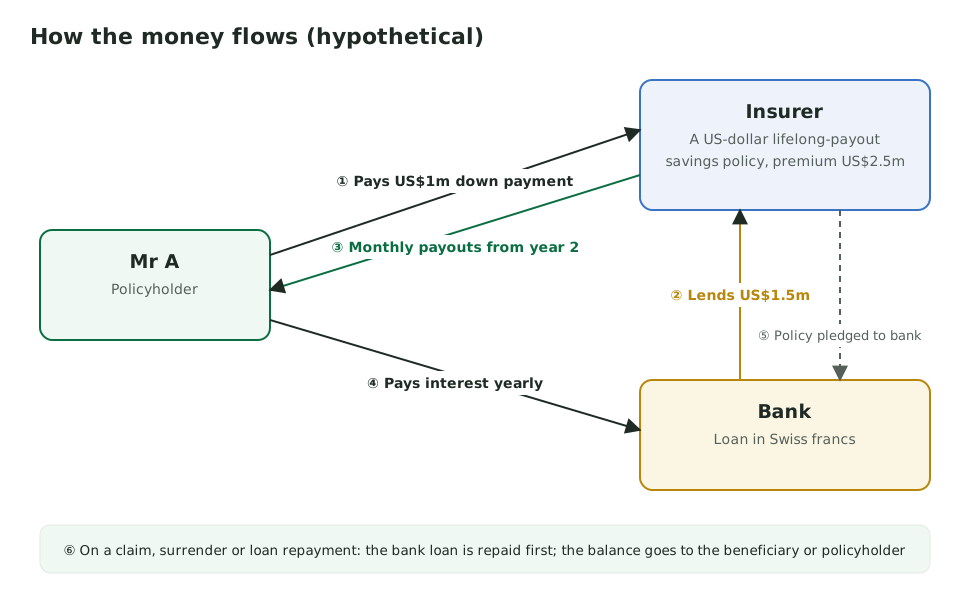
The loan and the policy can be in the same currency or in different currencies. Some clients borrow in a lower-interest currency, such as the Swiss franc (CHF), to pay the premium of a US-dollar policy, which adds a layer of currency risk.
Key concepts
| Concept | Meaning |
|---|---|
| Down payment (own funds) | The part of the premium the client pays personally. |
| Loan-to-value | The loan as a share of the premium or of the policy’s cash value, set by the bank. |
| Cash value | What the policy would pay if surrendered now; the bank uses it to set the loan limit and to decide whether to ask for a top-up. |
| Floating rate | Interest changes with market rates; rising rates increase the cost of holding the policy. |
| Top-up (margin call) | If the cash value falls relative to the loan beyond what the bank allows, the bank may ask for more cash, more collateral or partial repayment. |
| Currency mismatch | The loan and the policy are in different currencies, so exchange rate movements change what you actually owe. |
| Guaranteed and non-guaranteed | Benefits stated as “guaranteed” are paid under the contract; “non-guaranteed” benefits depend on the insurer’s future performance. |
A hypothetical example
All figures below are assumptions used to explain how premium financing works and how to calculate it. They do not represent the actual benefits of any specific product. Actual benefits depend on the policy’s product summary, benefit illustration and the bank’s loan terms.
Assumptions
- Policy: a participating savings policy with lifelong payouts, in US dollars, with a single premium and monthly payouts from the second policy year.
- Guaranteed payout: assumed at 1.6% of the premium a year.
- Non-guaranteed payout: assumed at up to 2.6% a year when illustrated at an investment return of 5.7% a year for the participating fund, for a total of 4.2% a year; at an illustrated return of 4.0% a year, the non-guaranteed payout is 1.43%, for a total of about 3.03% a year.
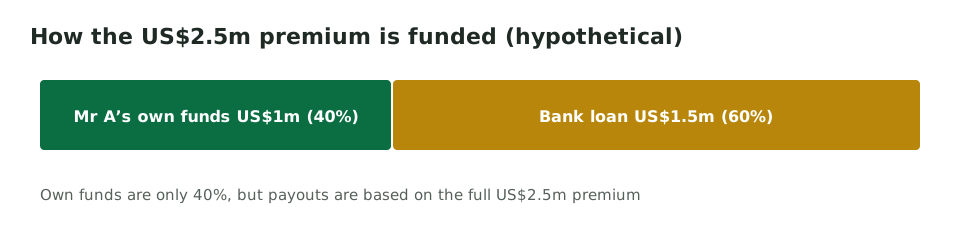
- Client: Mr A wants to put in US$1 million of his own money as the down payment.
- Financing: a bank loan of US$1.5 million, so the total premium is US$2.5 million and the loan is about 60% of the premium.
- Loan currency: assumed to be borrowed in Swiss francs, equal to US$1.5 million at the exchange rate at the time.
- Financing rate: assumed at 0.65% a year for CHF at the time, floating.
Yearly cash flow
Without financing, Mr A uses only his own US$1 million:
| Scenario | Yearly payout | As a share of own funds |
|---|---|---|
| Illustrated at 5.7% (4.2%) | US$42,000 | 4.2% |
| Illustrated at 4.0% (3.03%) | US$30,300 | 3.0% |
| Guaranteed only (1.6%) | US$16,000 | 1.6% |
With financing, the total premium is US$2.5 million: US$1 million of his own and US$1.5 million borrowed. Yearly interest is about 1.5 million × 0.65% = US$9,750 (assuming the exchange rate is unchanged).
| Scenario | Yearly payout | Less interest | Net yearly cash flow | As a share of own funds |
|---|---|---|---|---|
| Illustrated at 5.7% (4.2%) | US$105,000 | US$9,750 | US$95,250 | about 9.5% |
| Illustrated at 4.0% (3.03%) | US$75,750 | US$9,750 | US$66,000 | about 6.6% |
| Guaranteed only (1.6%) | US$40,000 | US$9,750 | US$30,250 | about 3.0% |
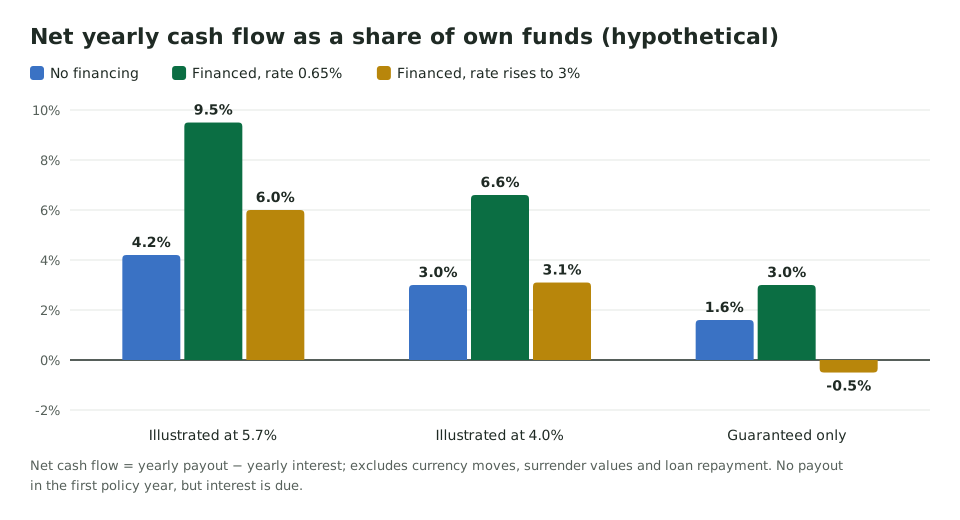
When the payout rate is above the financing rate, financing magnifies the difference onto Mr A’s own US$1 million. This is the “leverage” effect of premium financing. Note that:
- There is no payout in the first policy year, but interest is still due, so about US$9,750 must be paid from his own pocket that year.
- Only yearly cash flow is shown here; exchange rate changes, surrender values and eventual repayment of the loan are not included, so this is not the same as an investment return.
If interest or exchange rates change
Leverage magnifies both favourable and unfavourable changes.
Rising rates: if the CHF financing rate rises from 0.65% to 3%, yearly interest becomes US$45,000.
| Scenario | Yearly payout | Yearly interest | Net yearly cash flow |
|---|---|---|---|
| Illustrated at 5.7% | US$105,000 | US$45,000 | US$60,000 (about 6.0%) |
| Illustrated at 4.0% | US$75,750 | US$45,000 | US$30,750 (about 3.1%) |
| Guaranteed only | US$40,000 | US$45,000 | –US$5,000, to be covered from his own pocket |
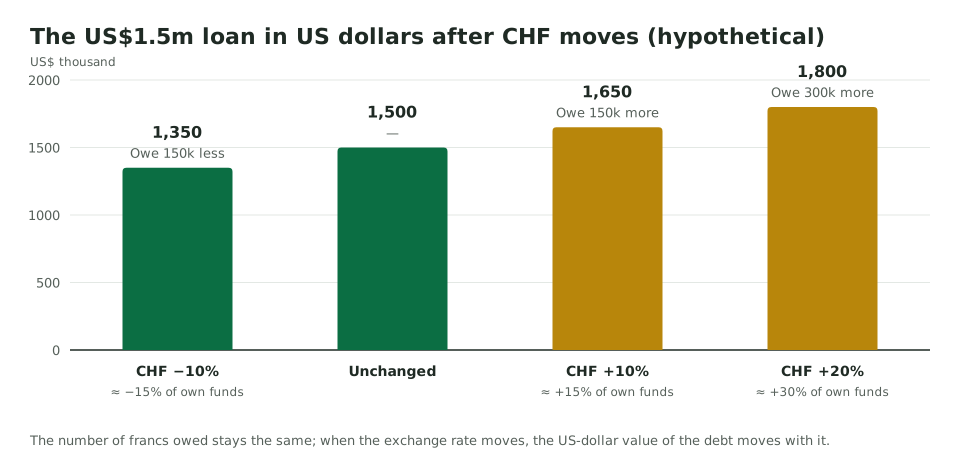
Exchange rates: the loan is in CHF and the policy in US dollars. If the Swiss franc rises 10% against the US dollar, Mr A still owes the same number of francs, but in US-dollar terms the loan grows from US$1.5 million to about US$1.65 million: roughly US$150,000 more, or about 15% of his own funds. A weaker franc would reduce the debt. Interest is paid in CHF and is affected in the same way.
Top-ups: assume the bank lends up to 90% of the policy’s cash value. Cash values are usually modest in the early years. If the franc rises sharply, non-guaranteed benefits come in below expectations, or the bank changes its lending policy so that the loan exceeds the allowed limit, the bank may ask Mr A for more cash or partial repayment. If he cannot provide it, the policy may be surrendered to repay the loan, usually at a loss in the early years.
Possible benefits
- Arrange a larger policy with less of your own money, for example higher death cover, larger payouts or a larger legacy.
- Keep part of your capital liquid for business, investments or emergencies.
- When the payout rate stays above the financing rate, the difference magnifies the cash-flow return on your own funds.
- Families with large legacy goals can lock in a larger policy earlier, to be passed to the next generation.
Usually suitable for
- People with substantial assets and stable cash flow who could keep paying interest even if payouts fall or rates rise
- People who understand and can bear interest rate, currency and top-up risks
- People planning to hold for the long term without surrendering early
Usually not suitable for
- People with unstable cash flow, or who rely on policy payouts to pay the interest
- People who cannot bear interest rate or currency swings
- People who may need the money within a few years
MoneySense cautions that premium financing increases the risk of losing coverage prematurely, and suggests considering it only if you could afford the premium without borrowing.
Risks to note
- Interest rate risk: rising floating rates increase holding costs and may make financing unattractive.
- Currency risk: when the loan and the policy are in different currencies, exchange rate moves directly change what you owe.
- Non-guaranteed benefits: the non-guaranteed part of payouts may fall below the illustration, down to the guaranteed part only.
- Top-ups: if the cash value falls relative to the loan, the bank may ask for more cash or partial repayment.
- Changes in bank terms: the bank may adjust the rate, loan-to-value or renewal conditions.
- Early surrender: early surrender values are usually below premiums paid, and the loan must be repaid first, magnifying losses.
- On a claim or at maturity, the bank loan is repaid first, so your family receives the balance after the loan.
Questions to ask
- What currency is the loan in? How is the rate set, and how much has it moved in recent years?
- What share of the cash value will the bank lend? What triggers a top-up?
- If only the guaranteed payout is paid and rates rise to 3% or more, how much would I need to pay myself each year?
- If the loan currency rises 10% or 20%, how much more would I owe?
- What are the surrender values in the early years? How much should I set aside in the worst case?
- When can the bank demand early repayment or decline to renew the loan?
Common misconceptions
Misconception: If the payout rate is above the loan rate, I always come out ahead?
Part of the payout is usually non-guaranteed and may fall; the loan rate floats and may rise; and if the loan and policy currencies differ, there is currency risk. All three need to be considered together.
Misconception: A larger policy through financing is always better value?
A larger policy also scales up the risks. Whether it is worthwhile depends on interest costs, exchange rates, payout levels and how long the policy is held, and results vary.
Misconception: I can exit the policy at any time at no cost?
Surrender values in the early years are usually below the premiums paid, and the bank loan must be repaid first on surrender, so exiting early usually involves a loss.
Official references
MoneySense “Understanding universal life insurance policies” (moneysense.gov.sg); MAS; the insurer’s product summary and benefit illustration; the bank’s loan terms (website: mas.gov.sg, moneysense.gov.sg)
← Group Insurance and Employee Benefits
All insurance guides · Protection planning · Book a consultation
Last updated: